West coast · Sant Josep
Torre d'en Rovira, Cala Comte: Ibiza's 1763 watchtower
A large round defensive tower of 1763 on the headland between Cala Comte and Cala Bassa, built to watch the west coast for ships.
Updated 19 September 2026
- Also called
- Torre de Comte
- Built
- 1763, design from about 1756
- Type
- First-class coastal tower
- Parish
- Sant Agustí des Vedrà
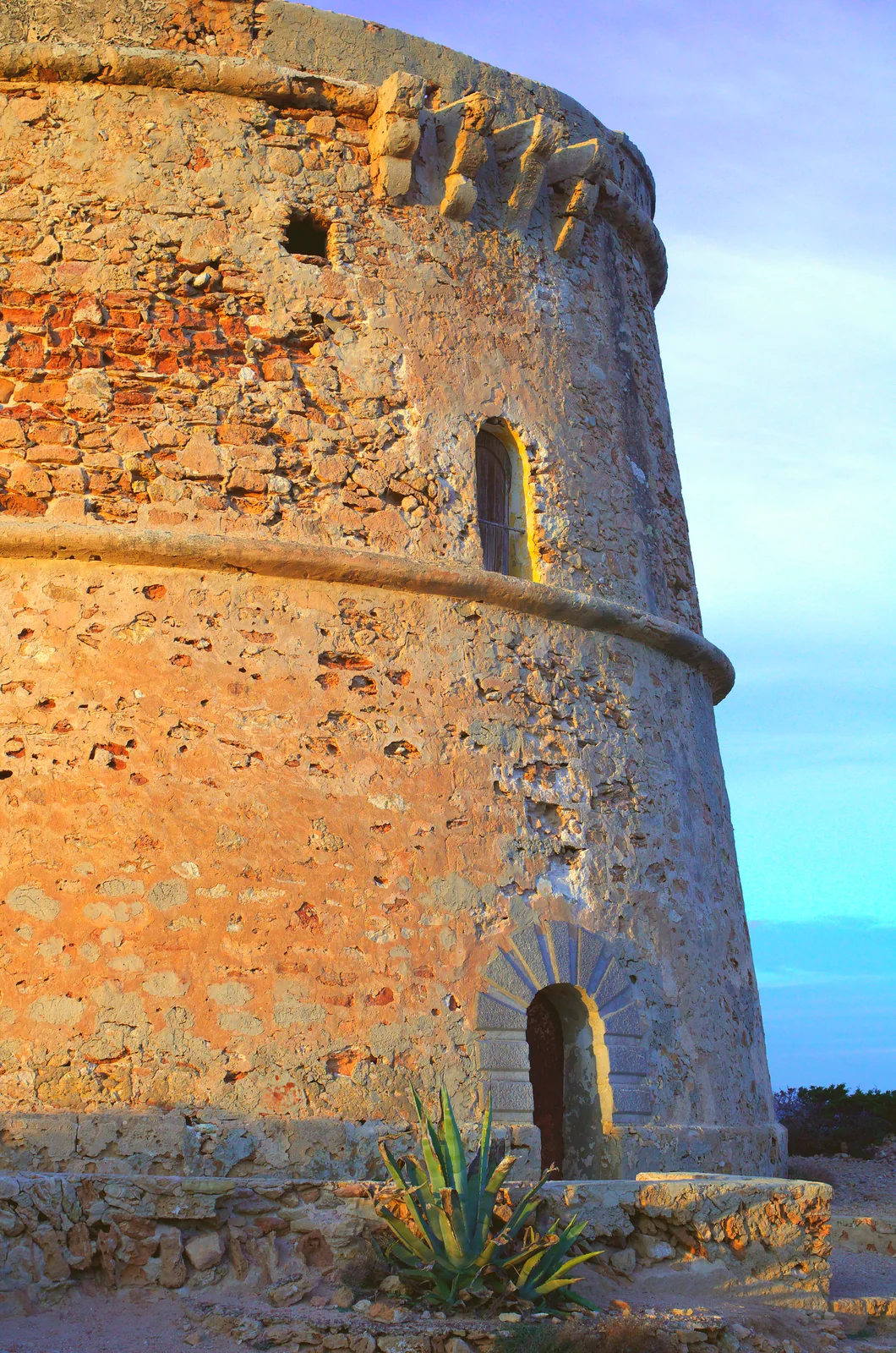
Walkers on the coast between Cala Comte and Cala Bassa see it before anything else: a heavy, round stone tower on the headland, dark against the sea. The Torre d'en Rovira, also known as the Torre de Comte, is one of the watchtowers that ring the island, and one of the biggest.
Why it was built
Ibiza's coast was open to attack from the sea, and the island's answer, between the 16th and 18th centuries, was a coastal system of watchtowers. The Torre d'en Rovira was built to guard the west coast, in the stretch between the church of Sant Antoni and the tower at Cap des Savinar. A tower of this size, on a headland with open sea to the west, gave a long view of approaching ships.
The design
The tower's design was drawn up by the engineer Ballester around 1756, and it was built by the engineer García Martínez in 1763. OpenStreetMap names the architect as Joan Ballester i Zafra and gives 1763 as the start date.
Sant Josep classes it as a first-class tower, larger in volume than other towers built at the same time in the Pitiusas. Two details are worth knowing:
- The door. The original entrance is on the first floor, well above the ground, as in many defensive towers.
- The matacáns. The tower still has four matacán brackets, the projecting supports for a defensive parapet from which stones could be dropped on attackers at the base.
A tower that became a house
For years the tower was used as a home, and its exterior was not greatly altered. Tourism sources describe it as still in very good condition. No notable defensive action is recorded for the tower; Sant Josep's page notes that it is not known to have taken part in any.
Where it stands
The tower occupies the tip of d'en Rovira, in the parish of Sant Agustí, on the headland about 1.3 km north-east of Cala Comte and a little over a kilometre from Cala Bassa. By straight line it is some 6.5 km from the harbour of Sant Antoni.
It makes a pleasant addition to a day at either beach, and the coast between them is the natural way to see it.
Visiting
Sant Josep's heritage page gives no opening hours, admission information or access instructions. Since the tower has been used as a dwelling, treat it as something to see from the outside and respect any signs or boundaries. For up-to-date access, ask at the municipality's tourism office or check locally.
Light and views
The tower's weathered stone changes colour through the day. In the evening light the walls turn gold, as in the photograph on this page, and the horizon behind them is the open sea towards the islets off the west coast. Because the coast faces west, the area is also a good place for the last hour of the day, when the sun sets over the water. The sunset clock on the home page shows the time.
Other towers
The Torre d'en Rovira is one of several 18th-century watchtowers around Ibiza. Another, the Torre de Portinatx, stands near Portinatx on the north coast. Together with the others around the island they form a system that can still be traced on the map, and walking from one to the next is a way to read the coastline.
Questions people ask
What is the Torre d'en Rovira?
A defensive watchtower on the west coast of Ibiza, in the parish of Sant Agustí des Vedrà. It is also called the Torre de Comte, after Cala Comte nearby. It was built to guard the coast between the church of Sant Antoni and the tower at Cap des Savinar.
When was the Torre d'en Rovira built?
The design was drawn up by the engineer Ballester around 1756, and the work was carried out by the engineer García Martínez in 1763. OpenStreetMap lists 1763 as the start date. It belongs to the 18th-century phase of the island's coastal defences.
Did the tower ever see battle?
Not that is recorded. Sant Josep's heritage page says it is not known to have taken part in any notable defensive action. Its job was to watch for ships and give warning.
Can you go inside the Torre d'en Rovira?
No visiting details are published by Sant Josep, and the tower was used as a home for years. The original door sits on the first floor, so it was reached by ladder. Treat it as a landmark to see from outside, and check locally for access.
Sources Sant Josep de sa Talaia – Torre de Comte (o d'en Rovira) · OpenStreetMap – Torre d'en Rovira
Nearby on the map
Cala Comte map: the beaches, the parking and the sunset rocks
A string of small sand coves and flat rock shelves on Ibiza's western tip, facing a scatter of islets across water so…
Cala Bassa beach, Ibiza: pine shade, shallow water and the way in
A wide golden cove facing north, with junipers and pines to the sand's edge, a gently shelving seabed and a bus stop…
West Ibiza · Sant JosepSant Agustí des Vedrà, Ibiza: map, church and the coast nearby
A spread-out parish on the Puig des Vedrà in western Sant Josep, with an unusual north-facing church, a wine-growing…